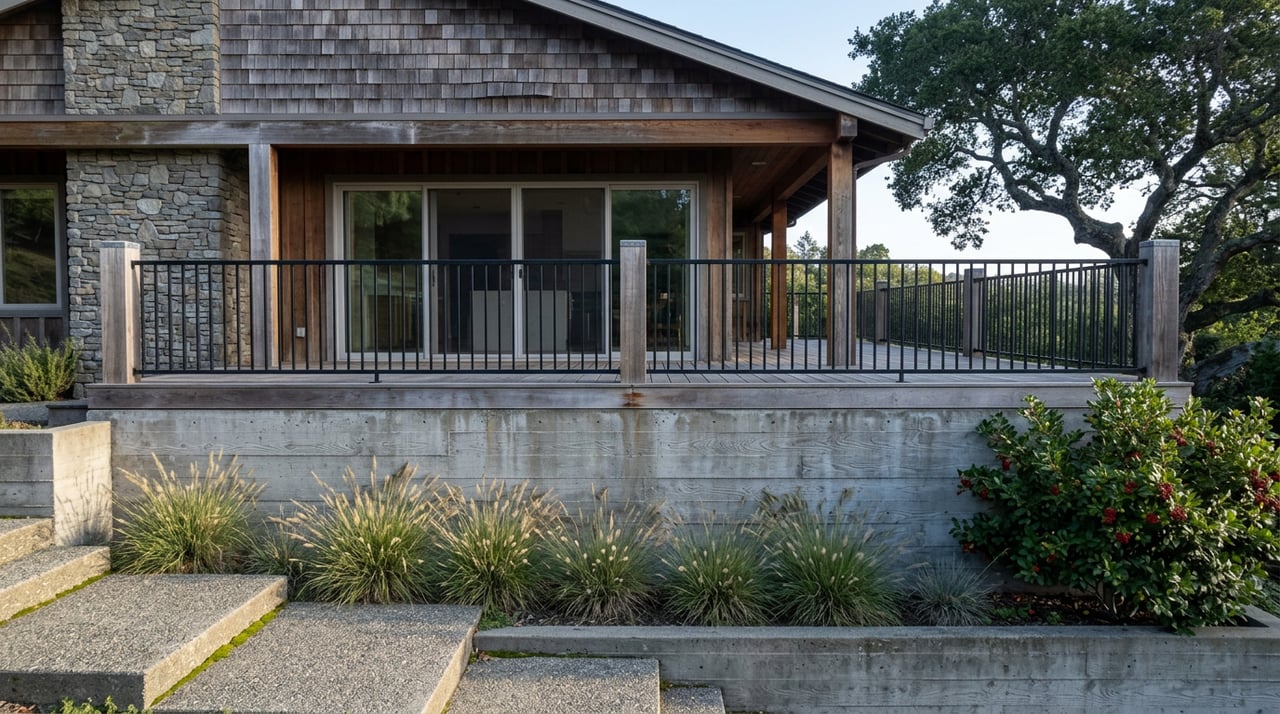
Buyers on the Tiburon Peninsula tend to describe the view the way they'd describe square footage: as something they own outright the moment escrow closes. A wall of glass facing Angel Island, the Golden Gate, the San Francisco skyline. Once it's yours, it's yours.
It isn't, not in the way most buyers assume. California has never recognized what old English law called the doctrine of ancient lights, the idea that a landowner earns a right to unobstructed light or view simply by enjoying it for years. A neighbor's cypress trees can grow for a decade and legally block your bay view, and absent a specific agreement, you have no automatic claim to stop them. What Tiburon and Belvedere have instead is something more interesting and more procedural: two nearly identical municipal ordinances that convert a blocked view into a public nuisance claim, complete with deadlines, a mediation requirement, and a name that keeps surfacing in California land use casebooks.
The Ordinance That 71 Cities Showed Up to Defend
Tiburon's view and sunlight ordinance lives in Chapter 15 of the town's municipal code, and Belvedere's near-twin is written into its own code at section 8.28.040. Both declare that a tree or hedge unreasonably obstructing a neighbor's view or sunlight is a public nuisance, and both give the aggrieved property owner a path to force a resolution.
The ordinance has been tested. In the 1990s, two apartment building owners in Tiburon, Gilbert and Heidi Kucera, used the ordinance against a neighbor named Tiberio Lizza over eight Monterey pines that had grown tall enough to block their view. A trial court sided with Lizza and struck the ordinance down as unconstitutional. On appeal, Tiburon didn't defend the case alone. Seventy-one California cities, from Chico to San Diego, filed briefs backing the town, and the appellate court upheld the ordinance as a legitimate exercise of a city's police power to protect scenic value. The case, Kucera v. Lizza, is still the reason your view rights in Tiburon or Belvedere work the way they do.
Here's the part that surprises most buyers: even under this ordinance, a protected view is not an easement that transfers with the deed. Belvedere's own code says so directly.
Access to a view or sunlight does not run with the land as an easement.
That single sentence is the whole thesis of buying on this peninsula. You aren't purchasing a legal guarantee. You're purchasing a process you can invoke if the view is later obstructed, one that only exists because a neighboring town's lawyers spent years defending it in court.
What the Process Actually Requires
If a tree grows in and blocks what you paid a premium for, the ordinance doesn't let you call an arborist and start cutting. It requires, in order:
- An informal attempt to resolve the dispute directly with the tree's owner
- A written complaint identifying the specific trees, the address, and a proposed remedy if informal talks fail
- Naming a certified arborist willing to do the corrective work
- An offer of mediation through Marin's mediation services, with binding arbitration as a fallback if mediation fails
- A hard filing deadline of 180 days after the complaint is served, or after mediation concludes, whichever comes later
That timeline matters in a way that rarely shows up in a listing description. If you're buying a home partly because of its view and you notice a neighbor's landscaping is trending toward obstruction, the clock on your remedy starts the day you formally complain, not the day the view actually disappears. Waiting to see how bad it gets can cost you standing.
It also explains why appraisers treat view corridors, topography, and any documented view easement as some of the most consequential details in a Tiburon or Belvedere valuation. Waterfront and hillside view properties turn over rarely enough that true comparables are scarce, so a well-maintained seawall, a permitted renovation, or paperwork showing a formal view arrangement can shift how the market reads a specific home, sometimes more than square footage does. None of that shows up on a portal listing. It shows up in the file a good escrow team assembles.
Below the View, the Ground Has Its Own Rules
The same hillside topography that creates the views creates a second, quieter friction point: what the ground underneath a home can actually support.
Tiburon requires a soils report for any hillside construction on a slope of 10 percent or greater, or whenever a structural engineer needs one to finalize a foundation and drainage design. Skip the soils report and your foundation is capped at a bearing load of 1,000 pounds per square foot. Bring in a structural engineer without a soils report and that ceiling rises to 1,500 psf. Commission an actual soils report and the ceiling can go meaningfully higher, depending on what the engineer finds.
For a design-conscious buyer eyeing a hillside property with plans to add a primary suite, cantilever a deck, or expand a footprint toward the view, this is the number that determines what's actually possible, not the aspirational sketch a listing agent shows at an open house. A home that looks capable of a substantial addition on paper may need a geotechnical report before anyone can say whether the foundation will support it. That report takes time and money, and skipping it doesn't remove the requirement. It just moves the surprise later into the project.
The Building Code Has Been Moving Too
If the ground rules feel stable by comparison, they aren't. Tiburon's building code around electrification has changed direction twice in under two years, and buyers relying on secondhand information about what's currently required are working from an outdated picture more often than they'd expect.
The town's original all-electric construction mandate ran into a legal problem in January 2024, when the Ninth Circuit invalidated a similar Berkeley ordinance on the grounds that federal energy law preempts local gas bans. Tiburon suspended enforcement of its own all-electric sections that February, anticipating the same challenge. The underlying ordinance stayed on the books, unenforced, for over a year.
Then, in August 2025, the Town Council introduced a repeal-and-replace package that brings electrification requirements back through a different legal structure, a point-based flex path that lowers the trigger for single-family alterations from 750 square feet down to 500. The town aimed to adopt the package by the end of August 2025 and file it with state energy regulators, with formal enforcement expected to begin sometime in 2026. In December 2025, the council layered on updated fire codes from the Southern Marin and Tiburon fire districts, tightening standards for access roads and vegetation clearance given the peninsula's steep terrain and dry conditions.
For anyone buying with renovation plans, particularly a kitchen remodel that assumes a gas range, or an addition planned around whatever building code applied when a listing photo was taken, the practical advice is simple: confirm the current requirement with the Town of Tiburon's building division directly before finalizing any design. What was true a year ago may not be true today, and what's true today may shift again before your permit is issued.
What This Actually Means When You're Under Contract
None of this changes the fact that the Tiburon Peninsula's views are genuinely rare and the demand for them is real. What it changes is what you should be asking for during due diligence. A seller with a documented history of good relations with view-adjacent neighbors, or paperwork on a prior mediated agreement, is offering something more durable than a photo of the bay at sunset. A buyer planning any hillside expansion should ask whether a soils report already exists for the property, because commissioning one after close adds weeks most escrow timelines don't have room for. And anyone with construction plans that assume a specific building code should verify that assumption against the town's current requirements rather than the requirements that were true when a comparable sale closed.
If you're weighing a purchase or a sale on the peninsula and want to know what the disclosure package, the soils history, or the current code status actually looks like for a specific address, that's the kind of groundwork worth doing before you write an offer. You can browse the Belvedere and Tiburon neighborhood guide, review what buyers should prepare for on a hillside purchase, or start with a home valuation that accounts for view corridor and site-specific factors rather than a flat median.
A Few Direct Questions
If a neighbor's tree already blocks part of my view before I buy, do I inherit any claim against it? The ordinance process attaches to the property owner at the time of the complaint, not automatically to a prior owner's grievance. If a view issue exists before you close, it's worth understanding the history and current state of any neighbor relationship before you rely on the view as part of your purchase decision.
Does Belvedere's ordinance work exactly like Tiburon's? The structure is nearly identical, informal resolution, mediation, and arbitration or litigation as a last resort, but each is its own municipal code, so a dispute involving properties in both jurisdictions should be reviewed against each code separately.
Does a soils report always add real time to a hillside purchase? If one doesn't already exist for the property, yes. Commissioning a geotechnical report is not something to leave until after the contingency period if your plans depend on knowing the foundation's actual capacity.
Real estate on this peninsula rewards buyers and sellers who understand the rules underneath the view, not just the view itself. If you'd like a second set of eyes on a specific Tiburon or Belvedere property, from the disclosure package to the soils question to what the current building code actually requires, Let's Connect with Paul O'Neil.