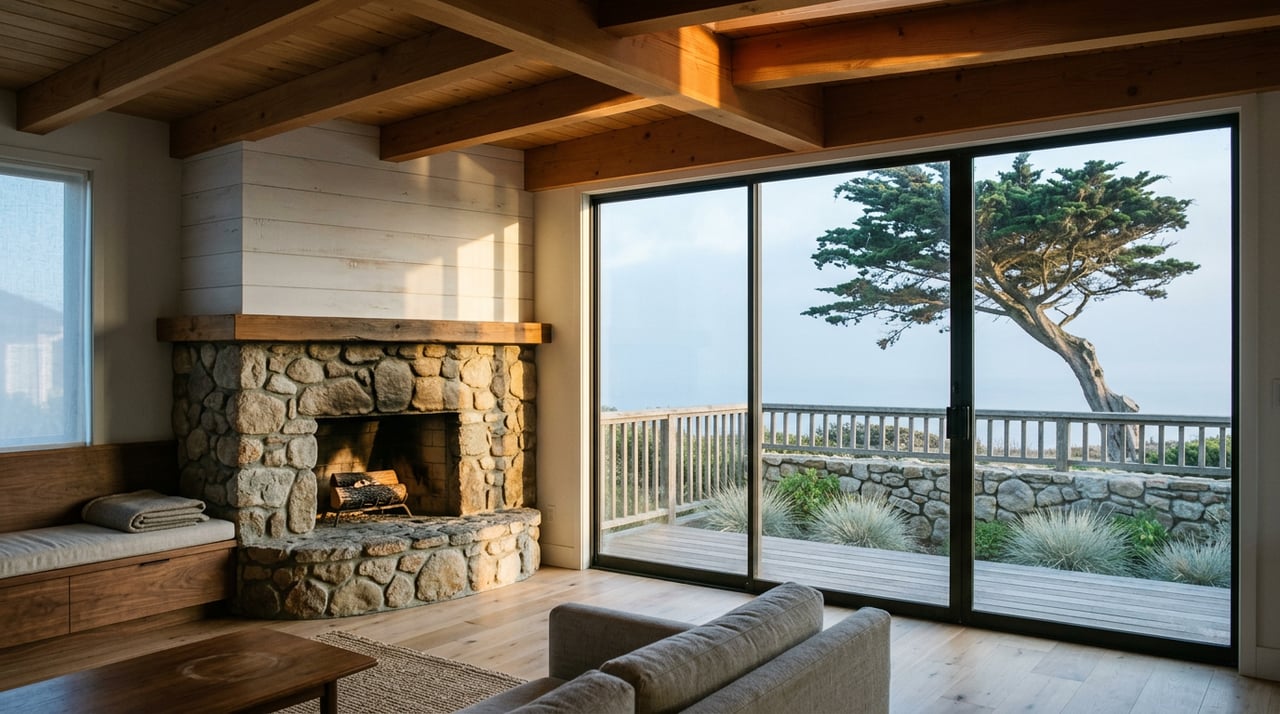
For most of the past several years, Stinson Beach's oldest restaurant sat dark. The Sand Dollar has been serving the town since 1921, built from three barges fused together into a single room that has hosted everything from Sunday bluegrass to, according to longtime regulars, the planning of a governor's wedding at a corner table. As of the summer of 2025, the family that has run it for a quarter century was still working toward reopening, and the general manager ticked through the list of things that had kept it closed: the pandemic, an illness in the family, an explosion in the building next door. And a failed septic system.
That last item is the one worth sitting with if you are shopping for a home here. A hundred-year-old institution with deep community goodwill and paying customers still had to solve a septic problem before it could turn its lights back on. In Stinson Beach, that is not an edge case. It is the operating condition of the entire town.
The House Comes With a Septic System, Not a Sewer Line
There is no municipal sewer in Stinson Beach. Every property, restaurant, cottage, or oceanfront estate treats its own wastewater on site through what the Stinson Beach County Water District calls an Onsite Wastewater Treatment System, or OWTS. That single fact does more to shape what you can actually do with a Stinson Beach property than the lot size, the zoning designation, or the view.
The district's rules draw a hard line between a remodel and what it defines as new construction. Cross that line and your OWTS has to meet current Title IV standards in full. A variance is possible, but only if your existing system is already engineered, in excellent working condition, and your planned square footage does not exceed what that system was designed to support. In practice, this means the ability to add a primary suite or convert a garage often has less to do with your architect's plans than with a septic engineer's report on a decades-old leachfield you have never seen.
When an upgrade is required, it is not a rounding error. Marin County's own Climate Change Action Plan estimated the cost to bring a single property's OWTS up to current standards at roughly $56,000 in 2023 dollars. Multiply that across a neighborhood and you start to understand why the county has floated a community wastewater system as a long-term alternative, one estimated at $15 million to serve the area collectively. Neither number appears on a listing sheet. Both belong in your due diligence.
What "Buildable" Actually Means on Calle del Onda
If you want to see how tightly this constraint operates even on a blank canvas, look at the last undeveloped beachfront parcel in town. The 15,200 square foot lot at 21 Calle del Onda has been in the same family since the 1930s, when their original cottage stood there before burning down. After nearly a decade of hearings, appeals, and a fight that reached the Marin County Board of Supervisors, the family won approval for a home. Not a mansion. A 1,296 square foot house, tied to a newly permitted septic system, on one of the largest lots on the beach.
The appeal against that approval leaned on the county's own sea level rise findings, and on a specific, recent memory: during the January 2023 atmospheric river storms, twenty Stinson Beach houses sustained damage and six septic systems failed outright. The supervisors approved the project anyway, weighing the property owner's right to reasonable use against the takings exposure the county would face if it said no. That tension, between what the coast is doing to the land and what the law says an owner is entitled to build on it, is not resolved. It shows up again every time a Stinson Beach property changes hands.
The Ground Is Already Voting on the Plan
The county has been studying this problem formally since 2022 through the Stinson Beach Adaptation and Resilience Collaboration, and the numbers that came out of it are specific enough to change how you should read a listing. Nearly half of all Stinson Beach properties sit on emergent or shallow groundwater, the kind that puts septic systems and buried utilities at flood risk long before the ocean itself reaches the front door. The plan the county presented to its Board of Supervisors in August 2025 prices the full menu of adaptation measures, raising roads and bridges, elevating the Seadrift and Bolinas lagoon bulkheads, building dune and cobble berms, and eventually replacing individual septic systems with a shared wastewater plant, at roughly $1.2 billion. Spread across the town's approximately 500 full-time residents, that is close to $2.4 million apiece, a number that only makes sense once you understand it is describing shared infrastructure risk, not a bill any single homeowner will receive directly.
One of the engineers who worked on the study put the stakes in plain terms:
"It's not like a ding in the pocketbook. This is that your home is gone."
This is no longer a hypothetical exercise. In August 2026, the California Coastal Commission approved the National Park Service's plan to rebuild Stinson Beach's public areas around the same adaptation logic, redesigning entrance roads, drainage, and pedestrian paths, restoring dunes and a floodplain, and removing 70 public parking spaces in the process. The tradeoff the Park Service is explicitly making, a smaller parking footprint for a more flood-resilient beach, is the same tradeoff private property owners are being asked to think through on their own parcels. The public infrastructure is moving first. The private infrastructure, your future septic upgrade or bulkhead repair, is the part the county has been clear it will not fund on your behalf.
Why the Median Price Is Measuring Almost Nothing
Given all of this, it should not surprise you that published price data for Stinson Beach reads like three different markets depending on which source you check, and it is not because any of them are wrong. It is because the sample size is tiny. Marin County property records tracked by one national data provider show only 19 residential transactions in Stinson Beach over a full year, with just one active listing at any given moment. Against that backdrop, a three month median sale price around $8.6 million reported in the spring of 2026, down nearly a fifth from the prior year, and a trailing twelve month median closer to $5 million reported separately for the same general period are not really contradicting each other. They are describing whichever handful of homes happened to close, whether that handful leaned toward an oceanfront Seadrift estate or a hillside cottage still running on its original 1940s leachfield.
That is the piece worth internalizing before you anchor on any single number you saw online. In a market this thin, the median tells you almost nothing about what a specific property is worth. What tells you something is the condition and capacity of that property's OWTS, its elevation relative to Easkoot Creek and the lagoon, and whether it has already been through a Title IV variance or is due for one.
What to Actually Ask Before You Make an Offer
Before you write an offer on a Stinson Beach property, get answers to these:
- Is the current OWTS an engineered system, and is there paperwork from the water district confirming it is in good working order?
- What square footage was the existing system designed to support, and does that number match what you plan to build or expand?
- Has the property been part of any coastal permit or variance filing with the county in the past decade?
- Where does the parcel sit relative to the groundwater and flood exposure mapped in the county's Stinson Beach Adaptation and Resilience Collaboration study?
None of these questions will show up on a standard disclosure form phrased this directly. Getting real answers usually means requesting the district's permit history for the address and asking your inspector to evaluate the OWTS with the same seriousness you would give a foundation.
A Few Direct Questions
Does every home in Stinson Beach really run on septic? Yes. There is no sewer system serving the town, so every property, commercial or residential, treats wastewater on site under rules set by the Stinson Beach County Water District.
Is the $1.2 billion adaptation plan a tax I would have to pay? Not directly. It is the county's estimate for the full menu of public and shared infrastructure work over decades, and the report itself notes the county has not committed additional public funding to protect private property. Individual OWTS upgrades and any private flood protection remain the property owner's responsibility.
Can I expand a small cottage in Stinson Beach? Sometimes, but expansion rights are tied to what your septic system was designed to handle, not just to zoning. A variance is possible if the current system is engineered and in excellent condition and your addition stays within its original capacity. Anything larger typically requires a full system upgrade before the county will approve new construction.
If you are weighing a Stinson Beach property against another stretch of the Marin coast, the conversation worth having isn't about the view. It's about what's underneath the house and what the county already knows about the ground it sits on. Paul O'Neil has walked Marin buyers through exactly this kind of due diligence, from septic history to coastal permitting, on properties across the peninsula. If you're looking at Stinson Beach or comparing it to Mill Valley, Tiburon, or another Marin neighborhood, let's connect before you make an offer, not after.